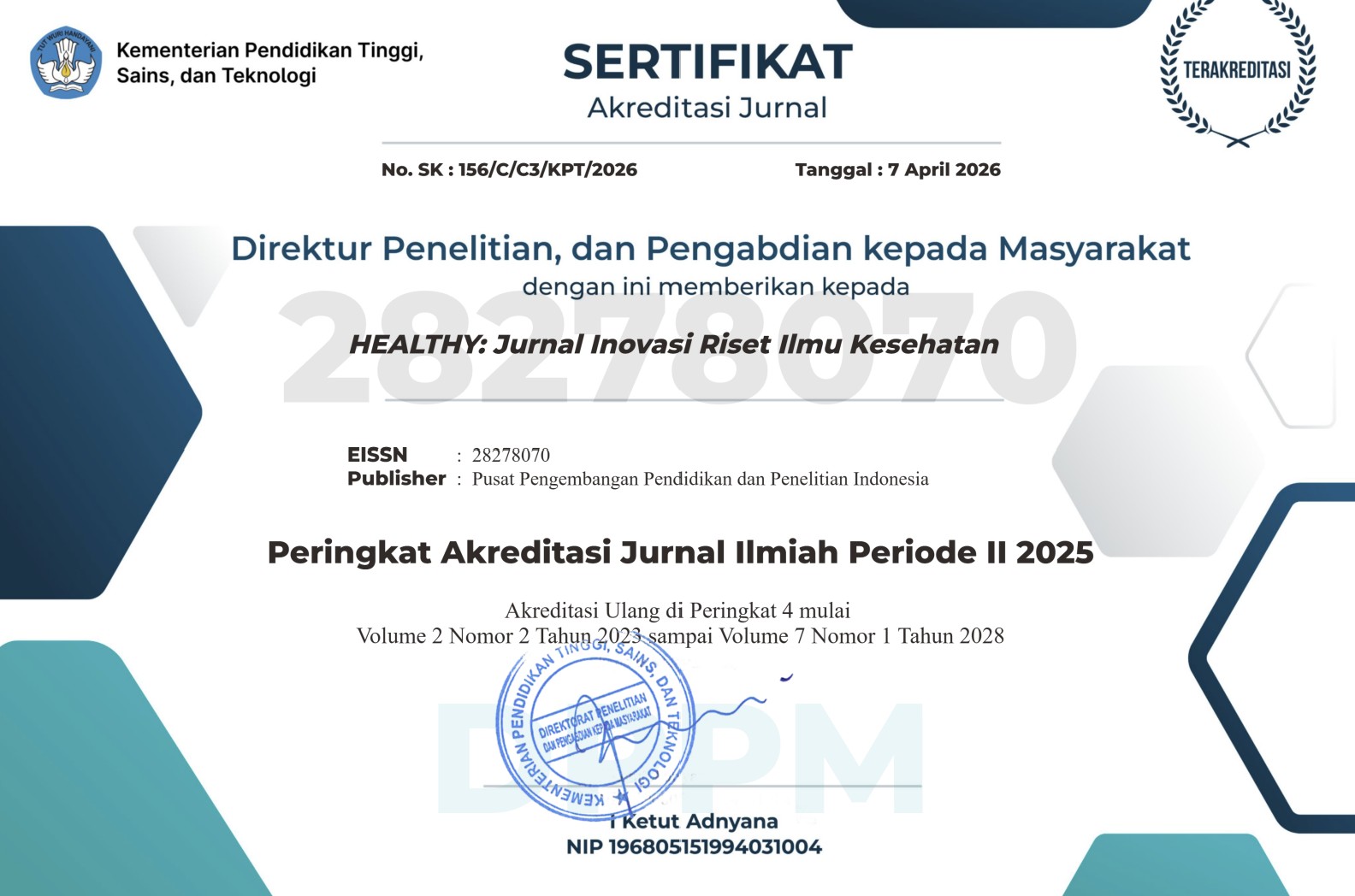
CASE REPORT: COGNITIVE BEHAVIOR THERAPY PADA PASIEN GAMBLING DISORDER DAN INTERNET GAMING DISORDER BERKOMORBID DENGAN GANGGUAN AFEKTIF BIPOLAR EPISODE KINI DEPRESIF SEDANG TANPA GEJALA SOMATIK
DOI:
https://doi.org/10.51878/healthy.v5i3.14123Keywords:
Gambling Disorder, Internet Gaming Disorder, Cognitive Behavior Therapy, Gangguan Afektif Bipolar, Adiksi PerilakuAbstract
ABSTRACT
Gambling Disorder (GD) and Internet Gaming Disorder (IGD) are behavioral addictions that can significantly impair psychosocial functioning and become more complex when comorbid with bipolar affective disorder. This case report aimed to describe the implementation of Cognitive Behavioral Therapy (CBT) combined with pharmacotherapy in a patient with comorbid GD, IGD, and bipolar affective disorder, and to evaluate the clinical outcomes following the intervention. This study employed a case report design involving a single patient. The assessment process included psychiatric interviews, heteroanamnesis, clinical observation, mental status examination, medical record review, and the administration of the South Oaks Gambling Screen (SOGS), Internet Gaming Disorder-20 Test (IGD-20), and University of Rhode Island Change Assessment (URICA) to establish the diagnosis, assess symptom severity, and evaluate the patient's readiness for treatment. Management consisted of pharmacotherapy based on clinical indications combined with structured CBT. Following the intervention, the patient demonstrated reduced craving, decreased frequency of addictive behaviors, improved mood, enhanced impulse control, and better psychosocial functioning. The patient also became able to identify triggers of addictive behaviors and apply more adaptive coping strategies. These findings suggest that integrating pharmacotherapy with CBT may provide an effective approach for managing patients with comorbid GD, IGD, and bipolar affective disorder by addressing biological, psychological, and behavioral aspects in a comprehensive manner.
ABSTRAK
Gambling Disorder (GD) dan Internet Gaming Disorder (IGD) merupakan adiksi perilaku yang dapat mengganggu fungsi psikososial dan semakin kompleks apabila disertai gangguan afektif bipolar. Laporan kasus ini bertujuan menggambarkan penerapan Cognitive Behavior Therapy (CBT) yang dikombinasikan dengan farmakoterapi pada pasien dengan komorbid GD, IGD, dan gangguan afektif bipolar, serta mengevaluasi luaran klinis setelah intervensi. Penelitian ini menggunakan desain laporan kasus (case report) pada satu pasien. Asesmen dilakukan melalui wawancara psikiatri, heteroanamnesis, observasi klinis, pemeriksaan status mental, telaah rekam medis, serta penggunaan South Oaks Gambling Screen (SOGS), Internet Gaming Disorder-20 Test (IGD-20), dan University of Rhode Island Change Assessment (URICA) untuk menegakkan diagnosis, menilai tingkat keparahan, dan kesiapan pasien mengikuti terapi. Penatalaksanaan dilakukan melalui kombinasi farmakoterapi sesuai indikasi klinis dan CBT secara terstruktur. Setelah intervensi, pasien menunjukkan penurunan craving, berkurangnya frekuensi perilaku adiktif, perbaikan suasana perasaan, peningkatan kontrol impuls, serta perbaikan fungsi psikososial. Pasien juga mampu mengenali pemicu perilaku adiktif dan menerapkan strategi koping yang lebih adaptif. Temuan ini menunjukkan bahwa integrasi farmakoterapi dan CBT berpotensi menjadi pendekatan yang efektif dalam penatalaksanaan pasien dengan komorbid GD, IGD, dan gangguan afektif bipolar melalui penanganan aspek biologis, psikologis, dan perilaku secara terpadu.
References
Andersland, M. D., Dow, C. V., Ginley, M. K., Whelan, J. P., & Pfund, R. A. (2025). Cognitive-Behavioral Therapy Techniques for Gambling Disorder: Practice Examples for Clinicians. Cognitive and Behavioral Practice. https://doi.org/10.1016/j.cbpra.2025.10.004
Arnani, K. D. N. (2021). Internet Gaming Disorder: Prevention Adolescent Programs for Indonesia. Jurnal Promkes: The Indonesian Journal of Health Promotion and Health Education, 9(1), 50–58. https://doi.org/10.20473/jpk.V9.I1.2021.50-58
Aulia, K., & Utami, M. S. S. (2025). Cognitive Behavioral Therapy (CBT) Approach In Adolescents With Online Game Addiction. Eduvest-Journal of Universal Studies, 5(4), 4719-4727. https://doi.org/10.59188/eduvest.v5i4.50111
B?och, M., & Misiak, B. (2024). Understanding the emergence of comorbidity between problematic online gaming and gambling: a network analysis approach. Brain Sciences, 14(9), 929. https://doi.org/10.3390/brainsci14090929
Bore, P., Nilsson, S., Andersson, M., Oehm, K., Attvall, J., Håkansson, A., & Claesdotter-Knutsson, E. (2024). Effectiveness and acceptability of cognitive behavioral therapy and family therapy for gaming disorder: protocol for a nonrandomized intervention study of a novel psychological treatment. JMIR Research Protocols, 13(1), e56315. https://doi.org/10.2196/56315
Brand, M., Antons, S., B?the, B., Demetrovics, Z., Fineberg, N. A., Jimenez-Murcia, S., ... & Potenza, M. N. (2025). Current advances in behavioral addictions: From fundamental research to clinical practice. American Journal of Psychiatry, 182(2), 155-163. https://doi.org/10.1176/appi.ajp.20240092
Eriksen, J. W., Fiskaali, A., Zachariae, R., Wellnitz, K. B., Oernboel, E., Stenbro, A. W., Marcussen, T., & Petersen, M. W. (2023). Psychological intervention for gambling disorder: A systematic review and meta-analysis. Journal of Behavioral Addictions, 12(3), 613-630. https://doi.org/10.1556/2006.2023.00034
Gupta, D., Bennett-Li, L., Velleman, R., George, S., & Nadkarni, A. (2021). Understanding internet gaming addiction in clinical practice. BJPsych Advances, 27(6), 383-393. https://doi.org/10.1192/bja.2020.81
Higueruela-Ahijado, M., Lopez-Espuela, F., Caro-Alonso, P. A., Novo, A., & Rodriguez-Martin, B. (2023). Efficacy of cognitive-behavioral therapy in improving the quality of life of people with compulsive gambling, a systematic review. Archives of Psychiatric Nursing, 43, 127-142. https://doi.org/10.1016/j.apnu.2022.12.014
Mestre-Bach, G., Granero, R., Mora-Maltas, B., Valenciano-Mendoza, E., Munguía, L., Potenza, M. N., ... & Jiménez-Murcia, S. (2022). Sports-betting-related gambling disorder: Clinical features and correlates of cognitive behavioral therapy outcomes. Addictive Behaviors, 133, 107371. https://doi.org/10.1016/j.addbeh.2022.107371
Molander, O., Ramnerö, J., Bjureberg, J., & Berman, A. H. (2022). What to target in cognitive behavioral treatment for gambling disorder—A qualitative study of clinically relevant behaviors. BMC psychiatry, 22(1), 510. https://doi.org/10.1186/s12888-022-04152-2
Moreira, D., Azeredo, A., & Dias, P. (2023). Risk factors for gambling disorder: A systematic review. Journal of gambling studies, 39(2), 483-511. https://doi.org/10.1007/s10899-023-10195-1
Mutlu, C., Birinci, T., Senel, A., Mustafaoglu, R., Bulan?k Koc, E., Karacetin, G., & Kaya Mutlu, E. (2024). A multi-dimensional assessment of internet gaming disorder in children and adolescents: A case-control study. Work, 77(4), 1089-1099. https://doi.org/10.3233/WOR-220652
Pfund, R. A., Forman, D. P., Whalen, S. K., Zech, J. M., Ginley, M. K., Peter, S. C., ... & Whelan, J. P. (2023). Effect of cognitive?behavioral techniques for problem gambling and gambling disorder: A systematic review and meta?analysis. Addiction, 118(9), 1661-1674. https://doi.org/10.1111/add.16221
Pfund, R. A., Rodda, S. N., & Weinstock, J. (2026). Cognitive-Behavioral Therapy for Gambling Disorder: Current Status and Future Directions. Cognitive and Behavioral Practice. https://doi.org/10.1016/j.cbpra.2026.05.006
Seo, E. H., Yang, H. J., Kim, S. G., Park, S. C., Lee, S. K., & Yoon, H. J. (2021). A literature review on the efficacy and related neural effects of pharmacological and psychosocial treatments in individuals with internet gaming disorder. Psychiatry Investigation, 18(12), 1149. https://doi.org/10.30773/pi.2021.0207
Siste, K., Hanafi, E., Murtani, B. J., Baigent, M., Riley, B. J., Sessions, J., Sen, L. T., Christian, H., Aryani, A., & Kusuma, K. S. (2024). Internet-based cognitive behavioral therapy for individuals with gambling disorder in Indonesia: protocol for a pilot and feasibility study. F1000Research, 13, 689. https://doi.org/10.12688/f1000research.151009.2
Stefanovics, E. A., & Potenza, M. N. (2022). Update on Gambling Disorder. The Psychiatric clinics of North America, 45(3), 483–502. https://doi.org/10.1016/j.psc.2022.04.004
Tran, L. T., Wardle, H., Colledge-Frisby, S., Taylor, S., Lynch, M., Rehm, J., ... & Degenhardt, L. (2024). The prevalence of gambling and problematic gambling: a systematic review and meta-analysis. The Lancet Public Health, 9(8), e594-e613. https://doi.org/10.1016/S2468-2667(24)00126-9
Valls, C. M., Håkansson, A., & Cervin, M. (2025). Understanding well-being among gamblers: The role of co-occurring psychopathology. Psychiatry Research, 352, 116715. https://doi.org/10.1016/j.psychres.2025.116715
Wang, X., Zhang, Y., Lin, J., Wong, A. C. W., Chan, K. K. Y., Wong, S. Y. S., & Yang, X. (2023). Treatments of internet gaming disorder and comorbid mental disorders: A systematic review and meta-analysis. Computers in Human Behavior, 149, 107947. https://doi.org/10.1016/j.chb.2023.107947
Wani, R. T., Rashid, I., Chowdri, I., & Qazi, T. B. (2022). An epidemiological study on factors influencing gaming disorder: An online cross-sectional design. Journal of Family Medicine and Primary Care, 11(5), 2114-2118. https://doi.org/10.4103/jfmpc.jfmpc_1701_21