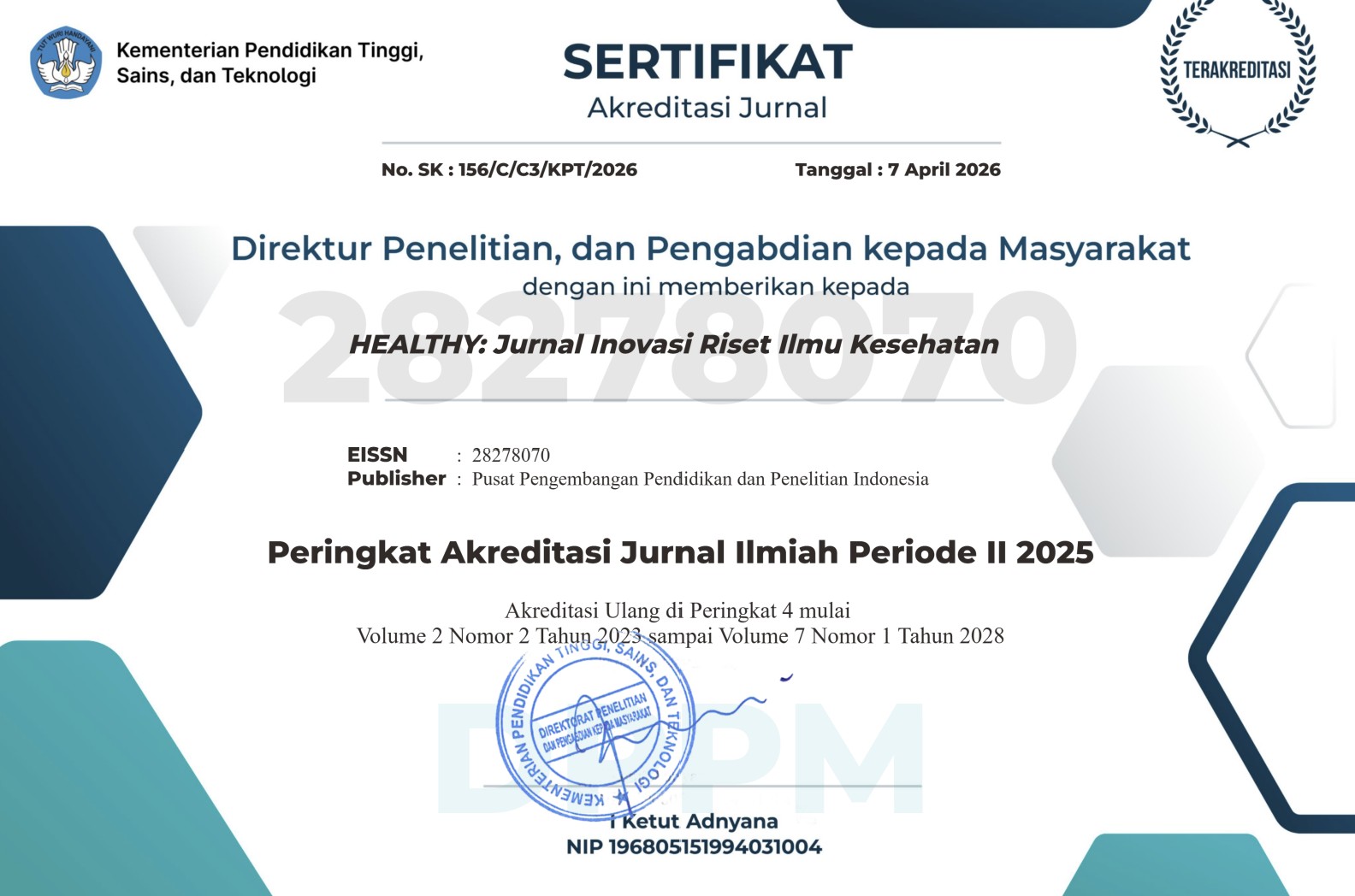
UJI AKTIVITAS ANTIBAKTERI DARI BEBERAPA JENIS LACTOBACILLUS DAN KOMBINASI BAKTERIOSIN DENGAN ANTIBIOTIK STANDAR TERHADAP BAKTERI RESISTEN
DOI:
https://doi.org/10.51878/healthy.v3i1.2674Keywords:
Antibakteri, Bakteriosin L. brevis, Pseudomonas aeruginosa MDR, MRSA, MRCNSAbstract
This study aims to examine the antibacterial activity of Lactobacillus brevis FNCC 0021, Lactobacillus delbrueckii FNCC 0045, Lactobacillus plantarum FNCC 0027, Lactobacillus rhamnosus FNCC 0052 and a combination of bacteriocins isolated from Lactobacillus that have potential with standard antibiotics against resistant microbes that cause nosocomial infections, namely: Pseudomonas aeruginosa Multidrug Resistant (MDR), MRSA and Methicillin Resistant Coagulase Negative Staphylococcus (MRCNS). Antibacterial activity testing uses the agar diffusion method to see the area of the inhibitory zone that appears and the microdilution method to see the minimum inhibitory concentration (MIC) and minimum bactericidal concentration (KBM). The test sample that has the greatest inhibitory power is continued with partial purification to obtain a purer bacteriocin. Then the antibacterial activity of bacteriocins and the combination of bacteriocins with standard antibiotics, namely: vancomycin, meropenem, tetracycline and ciprofloxacin, were tested. The culture supernatants of L. brevis, L. delbrueckii, L. plantarum, and L. rhamnosus have activity against resistant bacteria. L.brevis culture supernatant had relatively greater antibacterial activity against Gram-negative bacteria among the four test samples. The diameter of the inhibition zone for L. brevis against P. aeruginosa MDR, MRSA, and MRCNS was 11.2 ± 0.15 mm, 12.0 ± 0.23 mm and 11.8 ± 0.4 mm, respectively. The MIC and MIC of L. brevis supernatant against P. aeruginosa MDR and MRSA are relatively the same, namely 6.25% and 12.5%. Meanwhile, the KBM and MIC of L. brevis against MRCNS is 6.25%. The diameter of the inhibition zone of L. brevis bacteriocin compared to L. brevis supernatant against P. aeruginosa MDR was 14.7 ± 1.11 mm and 11.2 ± 0.65 mm, respectively. The combination of bacteriocins with standard antibiotics results in an increase in MIC. Culture supernatants of L. brevis, L. delbrueckii, L. plantarum, and L. rhamnosus have antibacterial activity against P. aeruginosa MDR, MRSA and MRCNS. L. brevis supernatant has better antibacterial activity against Gram-negative bacteria than other Lactobacillus. Bacteriocins are thought to have a role in the antibacterial activity of L. brevis supernatants. The interaction between L. brevis bacteriocin and the antibiotics tetracycline, ciprofloxacin and meropenem is antagonistic.
ABSTRAK
Penelitian ini bertujuan melihat aktivitas antibakteri Lactobacillus brevis FNCC 0021, Lactobacillus delbrueckii FNCC 0045, Lactobacillus plantarum FNCC 0027, Lactobacillus rhamnosus FNCC 0052 serta kombinasi bakteriosin yang diisolasi dari Lactobacillus yang potensial dengan antibiotik standar terhadap mikroba resisten penyebab infeksi nosokomial, yaitu: Pseudomonas aeruginosa Multidrug Resistant (MDR), MRSA dan Methicillin Resistant Coagulase Negative Staphylococcus (MRCNS). Pengujian aktivitas antibakteri menggunakan metode difusi agar untuk melihat luas zona hambatan yang muncul dan metode mikrodilusi untuk melihat nilai konsentrasi hambat minimum (KHM) dan nilai konsentrasi bakterisida minimum (KBM). Sampel uji yang mempunyai daya hambat paling besar dilanjutkan dengan purifikasi parsial untuk memperoleh bakteriosin yang lebih murni. Kemudian dilakukan pengujian aktivitas antibakteri bakteriosin dan kombinasi bakteriosin dengan antibiotik standar yaitu: vankomisin, meropenem, tetrasiklin, dan siprofloksasin. Supernatan kultur L. brevis, L. delbrueckii, L. plantarum, dan L.rhamnosus memiliki aktivitas terhadap bakteri resisten. Supernatan kultur L.brevis mempunyai aktivitas antibakteri terhadap bakteri Gram negatif relatif lebih besar diantara keempat sampel uji. Diameter zona hambat L. brevis terhadap P. aeruginosa MDR, MRSA, dan MRCNS berturut-turut 11,2±0,15 mm, 12,0±0,23 mm dan 11,8±0,4 mm. KHM dan KBM supernatan L. brevis terhadap P. aeruginosa MDR dan MRSA relatif sama yaitu 6,25% dan 12,5%. Sedangkan KBM dan KHM L. brevis terhadap MRCNS ialah 6,25%. Diameter zona hambat bakteriosin L. brevis dibandingkan supernatan L. brevis terhadap P. aeruginosa MDR, berturut-turut sebesar 14,7±1,11 mm dan 11,2±0,65 mm. Kombinasi bakteriosin dengan antibiotik standar menghasilkan peningkatan KHM. Supernatan kultur L. brevis, L. delbrueckii, L. plantarum, dan L. rhamnosus memiliki aktivitas antibakteri terhadap P. aeruginosa MDR, MRSA dan MRCNS. Supernatan L. brevis, mempunyai aktivitas antibakteri lebih baik terhadap bakteri Gram negatif dibandingkan Lactobacillus lainnya. Bakteriosin diduga memiliki peran dalam aktivitas antibakteri supernatan L. brevis. Interaksi antara bakteriosin L. brevis dengan antibiotik tetrasiklin, siprofloksasin dan meropenem bersifat antagonis.
References
Alekshun, M. N., dan Levy, S. B. (2007) : Molecular Mechanism of Antibacterial Multidrug Resistance, Review. Cell., 128, 1037-1049
Barbara, S. (2010) : Diseases and Disorder MRSA, Cengage Learning, Farmington Hills, 14-27
Bergeron, L.J., Bermudez, E.M dan Burne, R.A. (2000) : Characterization of the fructosiltransferase gene of Actinomyces naeslundii WVU45, J. of Biotechnology, 182(13), 3649-3654
Brooks, G.F., Butel, J.S., dan Morse, S.A. (2004) : Jawetz, Melnick & Adelberg’s Medical Microbiology, The McGraw-Hill Companies, Inc., 23th Edition, New York, 163-315
Center for Disease Control and Prevention (2013) : Antibiotic Resistance Threats In The United States 2013, U.S. Departement of Health & Human Services, http://www.cdc.gov/oid/BSC.html, diakses tanggal 22 Mei 2014
Darmadi (2008) : Infeksi Nosokomial Problematika dan Pengendaliannya, Penerbit Salemba Medika, 8-14
Dhewa, T. (2012) : Screening, Production Purification and Potential Use of Bacteriocins From Lactic Acid Bacteria of Meat and Dairy Food Origin, International Conference on Nutrition and Food Sciences (IPCBEE), 39, 35-41
Dwiprahasto, I. (2005) : Kebijakan Untuk Meminimalkan Risiko Terjadinya Resistensi Bakteri di Unit Perawatan Intensif Rumah Sakit, JMPK, 08 (04), 177-181
Ducel, G. (2002) : Prevention of Hospital-Acquired Infections, A practical Guide. 2nd Edition, New York: Department of Communicable disease, Surveillance and Response, 107-109.
Gautam, N. dan Sharma, N. (2009) : Purification and Characterization of Bacteriocin produced by strain of Lactobacillus brevis MTCC 7539, Indian journal of Biochemistry & Biophysics, 46, 337-341
Eijsink, V.G.H., Axelsson, L., Diep, D.B., Havarstein, L.S., dan Holo, H. (2002) : Production of class II bacteriocins by lactic acid bacteria; an example of biological warfare and communication, Kluwer Academic Publisher, 81, 639–654
Haller, D., Colbus, H., Ganzle, M.G., Scerenbacher, P., Bode, C., dan Hammes, W.P. (2001) : Metabolic and Functional Properties of Lactic Acid Bacteria in the Gastro-intestinal Ecosystem: A comparative in vitro Study Between Bacteria of Intestinal and Fermented Food Origin, Science Direct, Systematic and Applied Microbiology, 24, 218-226
Hernandez, D., Cardell, E., dan Zarate, V. (2005) : Antimicrobial activity of lactic acid bacteria isolated from Tenerife cheese: initial characterization of plantaricin TF711, a bacteriocin-like substance produced by Lactobacillus plantarum TF711, Journal of Applied Microbiology, 99, 77–84
Juuti., K. (2004): Surface protein Pls of methicillin-resistant Staphylococcus aureus Role in Adhesion, Invasion and Pathogenesis, and Evolutionary Aspects, Dissertation in General Microbiology, J. Academic, 2-5
Kerr, A.P. (2013) : The Bacteriostatic Spectrum and Inhibitory Mechanism of Glycocin F, a Bacteriocin from Lactobacillus Plantarum KW 30, Thesis Master of Science in Microbiology, Massey Univerity, Palmerston North, 61-80
Levinson, W., dan Jawetz, E. (2002) : Medical Microbiology & Immunology : Examination & Board Review, McGraw-Hill, 6th Edition, New York, 91-92
Lolans, K., Villegas, V.M., dan Quinn, J.P. (2008) : Antimicrobial Resistance Problem Pathogens and Clinical Counter Measures, Informa Healthcare, London, 149-160
Luellmann, H., Hein, L., Mohr, K., dan Bieger, D. (2005) : Color Atlas of Pharmacology, Thieme, 3rd Edition, New York, 268-283
Madigan, M. T., J. M. Martinko, dan J. Parker. (2003): Biology of Microorganism, 10th Edition, Pearson Education, London, 704-705, 741-742.
Malago, J.J, Koninkx, J.F.J.G., dan Logar, R.M. (2011) : Probiotic, Bacteria and Enteric Infections, Springer Science + Business Media, 4-24; 314-317; 393-396
Mariorakos, A.P., Srinivasan, A., Carey, R.B., Carmeli, Y., Falagas, M.E., Giske, C.G., Harbarth, S., Hindler, J.F., Kahlmeter, G., Olsson-Liljequist, B., Paterson, D.L., Rice, L.B., Stelling, J., Struelens, M.J., Vatopoulos, A., Weber, J.T., dan Monnet, D.L. (2011) : Multidrug-resistant, extensively drug-resistant and pandrug-resistant bacteria: an international expert proposal for interim standard definitions for acquired resistance, Clin MicrobiolInfect, 18, 268-281
Malago, J.J, Koninkx, J.F.J.G., dan Logar, R.M. (2011) : Probiotic, Bacteria and Enteric Infections, Springer Science + Business Media, 4-24; 314-317; 393-396
Marshall, S.H., (2003) : Antimicrobial Peptides: As Natural Alternative to Chemical Antibiotics And a Potential for Applied Biotechnology, Electron J Biotechno, (6) 2, 3-6
Mulvey, M.R., dan Simor, A.E. (2009) : Antimicrobial Resistance in Hospital : How Concerned should we be?, Can Med Assoc J., 408-414
Neal, J. (2005) : Medical Pharmacology at Glance, 5th Edition, Blackwell Publishing Ltd, New Jersey, 80-85
Oakey, L., Carroll, K., McClean, S., Keller, F., Costello, M., dan Behan, J. (2000) : Antimicrobial peptide-alternative to antibiotics?. Institute of Technology Tallaght, Dublin
Ogunbanwo, S.T., Sanni, A.I., dan Onilude, A.A. (2003) : Characterization of bacteriocin produced by Lactobacillus plantarum F1 and Lactobacillus brevis OG1, African Journal of Biotechnology, 2 (8), 219-227
Palavecino, E. (2007) : Clinical, Epidemiological, and Laboratory Aspects of Methicillin-Resistant Staphylococcus aureus (MRSA) Infections, Humara press Inc., New Jersey, 39-47
Pitingore, E.V., Salvucci, E., Sesma, F., dan Nader-Macias, M. E., (2007) : Different strategies for purification of antimicrobial peptides from Lactic Acid Bacteria (LAB), Communicating Current Research and Educational Topics and Trends in Applied Microbiology, 557-568
Prakash, B., Shekar, M., dan Karunasagar, I. (2011) : Evaluation of antimicrobial activity of Lactobacillus species associated with dentures, Biotechnol. Bioinf. Bioeng. Society for Applied Biotechnology, (1) 2, 235-239
Prescott, Lansing, M., dan Harley, J.P. (2003): Microbiology, 5th Edition, The McGraw Hill Companies, Inc., New York, 529-532
Reed, K.D., Stemper, M.E., dan Shukla, S.K (2007) : MRSA Case Studies, Humara press Inc., New Jersey, 21-27
Republik Indonesia (2011) : Peraturan Menteri Kesehatan Republik Indonesia Nomor 2406/MENKES/PER/XII/2011 Tentang Pedoman Umum Penggunaan Antibiotik, Berita Negara RI No.874, 2011, Kementerian Kesehatan Republik Indonesia
Restiati, A. (2014) : Uji Aktivitas Antibakteri Supernatan Kultur Lactobacillus acidophilus, Lactobacillus bulgaricus, dan Lactobacillus casei Terhadap Bakteri Resisten, Tesis, Institut Teknologi Bandung, 24-25
Satari, M.H. (2002) : Fenomena Molekuler Enzim betalaktamase S. Aureus resisten ampisilin Sulbaktam, Desertasi, Universitas Padjadjaran, 14-23
Savadogo, A., Outtara, C.A.T., Bassole, I.H.N., dan Traore, A.S. (2004) : Antimicrobial Activities of Lactic Acid Bacteria Strains Isolated from Burkina Faso Fermented Milk, Pakistan Journal of Nutrition (3) 3, 174-179
Sears, B.W., Spear, L., dan Saenz, R. (2007) : Hardcore Microbiology and Imunology, Lippincott Williams & Wilkins, Chicago, 1-3
Spicer, J.W. (2008) : Clinical Microbiology and Infectious Diseases, Elsevier Limited, 2nd Edition, Philadelphia, 218-219
Stevens, K.A., Sheldon, B.W., Klapes, N.A. (1991) : Nisin Treament for Inactivation of Salmonella Species and Other Gram-Negative Bacteria, American Society for Microbiology, (57) 12, 3613-3615
Supriyantoro (2011) : 7th National Symposium of Indonesia Antimicrobial Resistance Watch, Cermin Dunia Kedokteran, (38) 6, 474
Upreti, G.C. dan Hinsdill, R.D. (1975) : Production and Mode of Action of Lactocin 27: Bacteriocin from a Homofermentative Lactobacillus, Antimicrob Agents Ch, (7) 2, 139-145
Usmiati, S., dan Rahayu, W.P. (2011) : Aktivitas Hambat Bubuk Ekstrak Bakteriosin Dari Lactobacillus sp. Galur SCG 1223, Prosiding Pada Seminar Nasional Teknologi Peternakan dan Veteriner, PusLitBang Peternakan, 388-397
Weigelt, J.A. (2007) : MRSA, Informa healthcare, New York, 21-42
Zhenbo, X., Li, L. Z.X., Chu, J., Li, B., Shi, L., Su, J., dan Shirtliff, M.E. (2011) : Development and application of a novel multiplex polymerase chain reaction (PCR) assay for rapid detection of various types of staphylococci strains, Afr J Microbiol Res, 5(14), 1869-1873